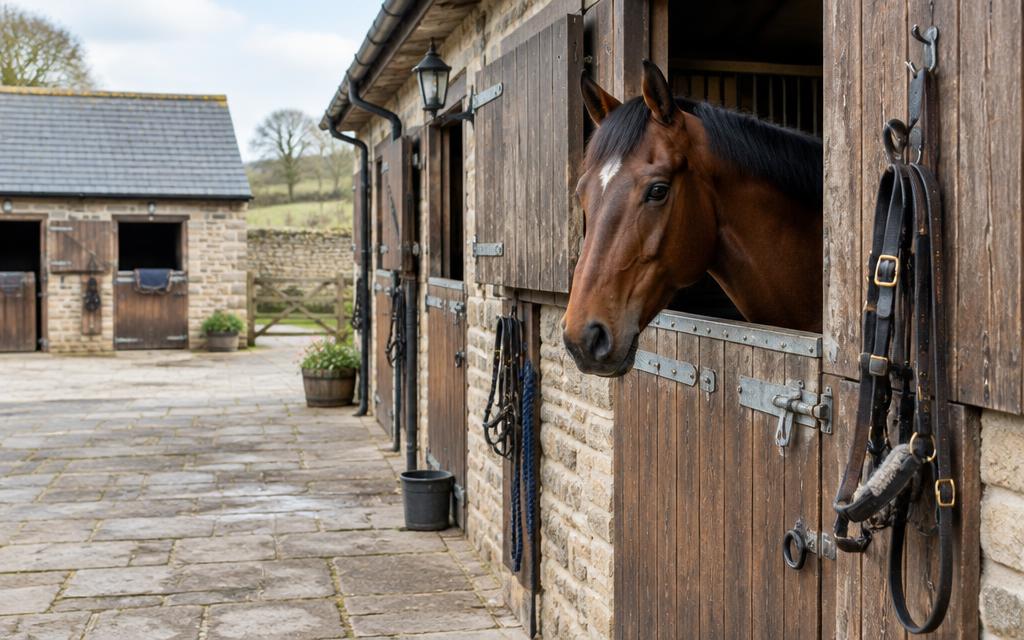
Short answer: price livery from your own costs up. Add up what each stable costs you a month, add your time, add a margin, then price extras like turnout, clipping and worming separately so they don't vanish into the monthly fee.
Prices vary a lot by region, facilities and what's included, so I won't give you a "UK average" I can't stand behind. What I can give you is the method we used at our family yard.
Step 1: Work out your cost per stable
Add up a month of yard costs: rent or mortgage share, hay, bedding, feed, water, electricity, insurance, muck removal, maintenance and arena upkeep. Divide by the number of stables you let.
*Example figures only:* £4,800 a month in costs across 12 stables is £400 per stable before any of your time.
Step 2: Add your time
Full livery is mostly labour. Estimate the hours per horse per week — mucking out, feeding, turnout, rugging, checks — and put a real hourly value on it. Part and DIY livery need less, so they should cost less.
Step 3: Add a margin
Your price needs room for vet emergencies, broken fencing and the month a livery leaves without notice. Decide the margin on purpose instead of hoping it's there.
Step 4: Price the extras separately
Extras are where yards lose money. List them, price each one, and record them when they happen:
- Additional turnout or bringing in
- Clipping
- Worming
- Holding for the farrier or vet
- Rug changes and washing
- Exercising or schooling
The guide to billing livery extras covers how to record these before they're forgotten.
Step 5: Put it on the invoice clearly
One line for the monthly livery, then one line per extra with a quantity and price. Clear invoices get fewer questions and get paid faster. See the livery yard invoice app for how this looks when you say it as a voice note, or the equestrian invoicing software page.
Frequently asked questions
How do I decide what to charge for full livery?
Start from your cost per stable, add the hours you spend on each horse at a fair hourly value, then add a margin. Check what nearby yards with similar facilities charge so you're not far off the local market.
Should extras be included in the livery price?
Usually it's fairer and clearer to price regular extras like additional turnout, clipping and worming separately. Liveries who use them pay for them, and you don't absorb the cost.
How often should I review livery prices?
At least once a year, and whenever hay, bedding or energy costs move noticeably. Give liveries written notice before a price change.
What's the easiest way to invoice livery extras?
Record each extra when it happens. With SaidToPaid you can say "Invoice Sarah for October full livery, clipping and three extra turnouts" and it builds the itemised invoice for you to check and send.
Try it with your numbers
Livery cost calculator
Put in your weekly yard costs and the number of horses sharing them to see a minimum price per stable.
- Cost per horse per week
- £122.00
- Minimum price per week
- £140.30
- Per calendar month
- £607.97
A starting point worked out from your figures only. Nothing is saved. Excludes VAT.
Use these prices on a free invoiceInvoice terms you can copy
Plain wording to add to the notes on your invoices. Save it once in your settings and it goes on every invoice. General guidance, not legal advice.
Late payment (business customers)
Payment is due within 30 days of the invoice date. If you are a business customer, we may charge interest on late payment at 8% a year above the Bank of England base rate, plus fixed compensation, under the Late Payment of Commercial Debts (Interest) Act 1998.
Payment in advance and notice
Livery is payable monthly in advance. Either party may end this agreement with 30 days' written notice.
Vet and farrier authority
If we cannot reach you in an emergency, you authorise us to call a vet or farrier for your horse. Their fees will be added to your next invoice.
Extras
Extra services such as clipping, additional turnout, rugging changes and wormers are charged at the rates in our price list and shown on your invoice.
The late payment law only covers business-to-business invoices. Fixed compensation is £40 on debts under £1,000, £70 up to £9,999.99 and £100 from £10,000.
Livery yard checklist (UK)
- Give every client a written livery agreement covering services, prices, notice and what happens if bills go unpaid.
- Every horse must have a passport, and in England a microchip. Check them when a horse arrives.
- Agree your yard's vaccination rules, such as equine flu, in writing. Many yards and competitions require it.
- Have care, custody and control insurance as well as public liability.
- List extras with clear prices so clipping, turnout and wormers end up on the invoice.
General guidance, checked October 2026. Rules change and vary by council, so check with your local authority, insurer or HMRC.
From individual Trustpilot reviews
A customer's experience
“I run a livery yard and was constantly putting off invoicing until the evening. SaidToPaid lets me create invoice drafts from voice notes while I’m working, which has made keeping on top of payments much easier. It’s simple to use on my phone and saves me a lot of admin time.”